
Sleep & heart · topic 6 of 7
Night HRV
Your own baseline, one writer at a time — and what SDNN is not
Verve reads whatever HRV reaches Apple Health, names the writer and its method, and keeps each writer’s baseline apart. Here is why that matters. Heart rate variability is the beat-to-beat unevenness of a resting heart: a heart that speeds a little on each breath in and slows on each breath out is being steered by the vagus nerve, and the more freely it is steered, the larger the variation. That is what the number measures, and it is all it measures. It is not a fitness score, and it is not a readiness score, whatever the dashboard beside it says.
SDNN
What it is. The standard deviation of all the beat intervals in the window: how widely the beats are spread around their own average. It takes in every rhythm present, fast and slow.
For. The clinical standard over 24 hours, the definition of Apple Health's one HRV field, and what Apple Watch measures and writes.
Against. The slow rhythms need time to show, so its value depends on how long the window is: a 1-minute SDNN and a 24-hour SDNN are different quantities with one name. Over Apple's windows of about 1 minute a single sample is noisy; a night's median of them tames that.
rMSSD
What it is. The root mean square of the differences between each beat and the next: how much the interval jumps from one beat to the one after.
For. Only a fast rhythm can move a beat against its neighbour, and the fast rhythm at rest is breathing, steered by the vagus nerve, so it is close to a pure read of vagal tone, barely cares how long the window is, and is steadier in short windows. The research favourite for athlete monitoring, and the ring makers' choice.
Against. It needs clean beats: a single missed or doubled beat is a large jump, and the squaring makes it larger. And it is not what Apple's field means: a ring's number and a watch's are not the same quantity, so they must never share a baseline.
At night, at rest, with the sympathetic drive low, the two track each other closely, because both are then dominated by the same thing: the breathing-driven vagal variation. For a personal baseline neither is “better”, provided the two are never mixed on one line: an rMSSD of 60 and an SDNN of 60 are not the same night, and a chart that holds both is a chart of the switch between them.
Who writes HRV to Apple Health
| Wearable | Its HRV method | Writes HRV to Apple Health? | Note |
|---|---|---|---|
| Apple Watch | SDNN | Yes, as SDNN | Samples of about 1 minute, several a night; Verve takes the median of the ones inside the sleep window. |
| Oura | rMSSD | No HRV, per third-party reports | Sleep and resting rate reach Apple Health; the HRV stays in the Oura app. |
| WHOOP | rMSSD | No HRV, confirmed in Health's and Health Connect's write lists (Oct 2026) | Writes sleep, heart rate, resting rate, respiratory rate, steps and workouts; HRV is not on the list. WHOOP's stated reason: writing rMSSD into a field defined as SDNN would mislead. |
| Garmin | rMSSD | No HRV, per third-party reports | Garmin's own status reads rMSSD over the night; it is not written to Health. |
| HRV4Training, Elite HRV | rMSSD-based | Yes, into the SDNN field | A chest-strap or camera reading, written by the app under Apple's one HRV type. |
Apple Health has one HRV type, and its definition is SDNN. Apple Watch writes SDNN into it. Oura, WHOOP and Garmin compute rMSSD and, per third-party reports, do not write HRV to Apple Health at all. Some chest-strap and camera apps write rMSSD-based values into the SDNN field, which is why Verve reads the writer’s name as well as the number.
So is there anything to choose?Usually not. With an Apple Watch and any of Oura, WHOOP or Garmin, the Watch is the only writer of HRV, and Verve’s Preferred device row for night HRV simply says so. The one exception is a chest-strap or camera app such as HRV4Training or Elite HRV, which writes its own rMSSD-based number into the same field. Then two writers exist, and Settings → Apple Health → Preferred device lets you name which leads. Each writer keeps its own baseline either way.
Vendor behaviour changes; this table is checked against the vendors’ Apple Health pages before each release.
How a night is read
Verve’s rules.One writer per night: a night with samples from two sources is read from one of them, never averaged across both. The writer and its method are printed on the card, “Apple Watch · SDNN”, or “HRV4Training · rMSSD”, or “method undeclared” where the writer does not say. The baseline is kept per writer, so a new writer starts a new band from its own first night rather than being judged against the old writer’s. Two methods never share a line. The sleep window is the one the sleep timing page describes.
When the Guide says anything at all.The Guide names a pattern only when night HRV,resting heart rate andone-minute recovery all leave their own bands in the same direction, HRV low, resting rate high, recovery small, for 3 nights. Three readings agreeing for three nights is a pattern worth a sentence. One reading on one night is not, and the Guide stays quiet.
Two readings beside the night
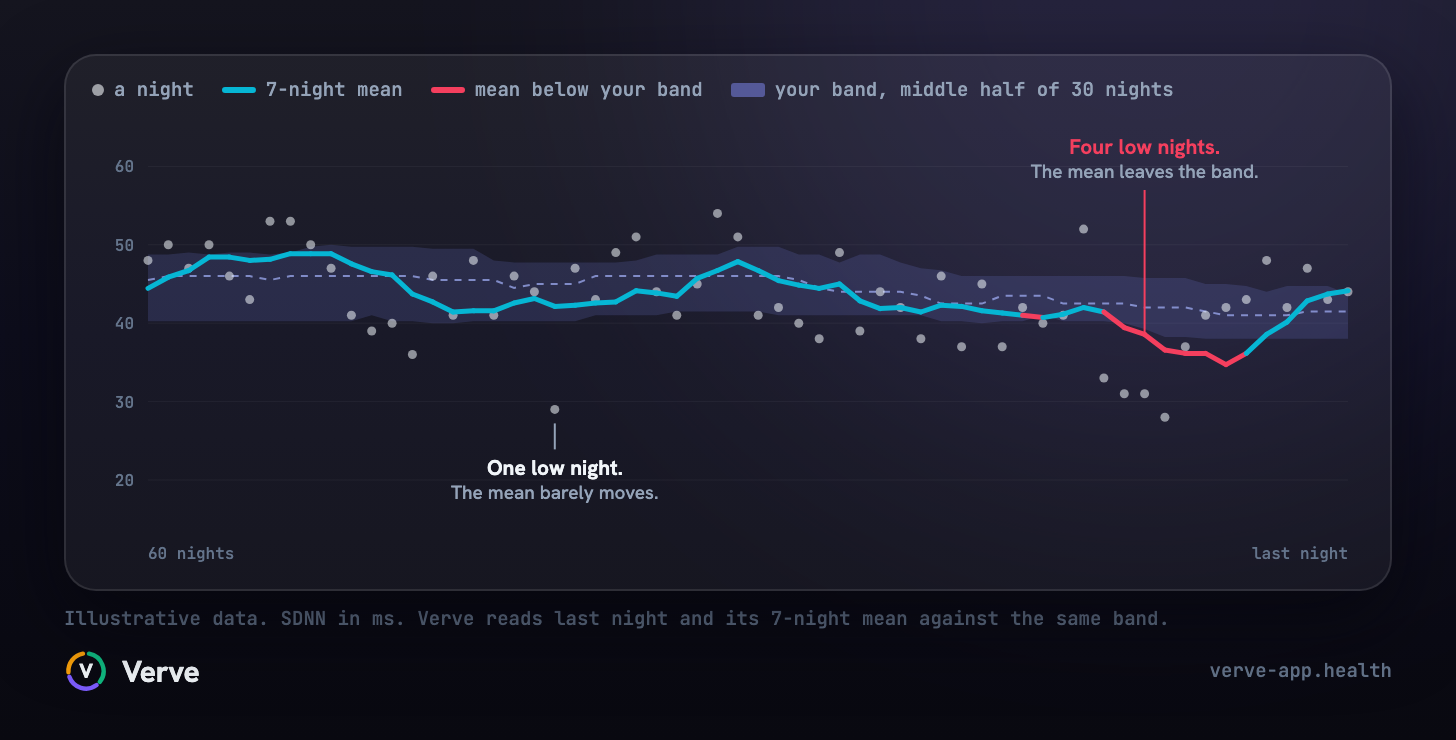
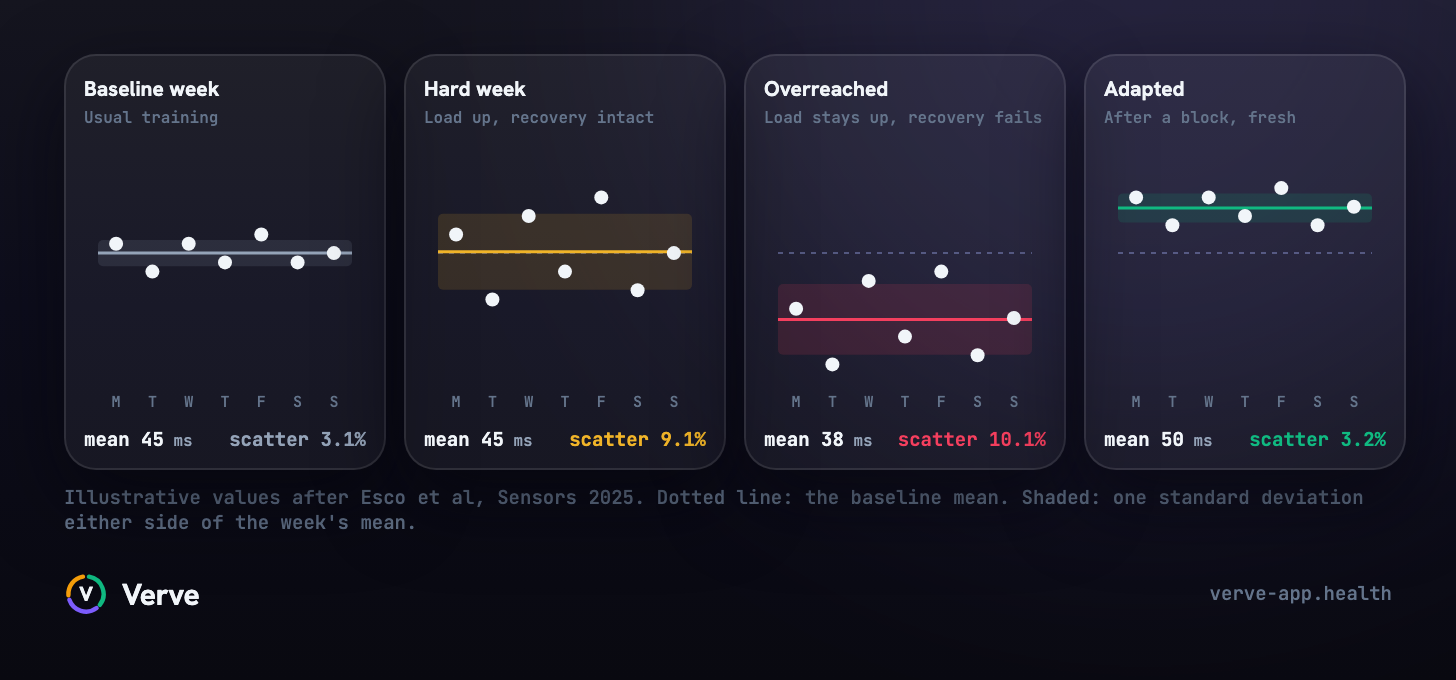
A single night is noise. The athlete-monitoring literature acts on two numbers instead, and from October 2026 Verve shows both. The first is the7-night mean: every night, the last seven nights averaged, drawn as a line through the nights on the Day view and read against the same band as the night itself. It is shown from 3 nights, the minimum Plews found could stand in for a week, and marked settled at 7. The second is theweek’s scatter: the standard deviation of a fixed week’s nights as a share of their mean, the coefficient of variation, printed on the Week and Month views beside the period before.
On Android, Health Connect’s one HRV type is defined as rMSSD, the opposite choice to Apple’s. Verve’s Android build does not read it yet; when it does, the same rules apply, and an Android rMSSD baseline will never be drawn on an Apple SDNN line.
Task Force of the ESC and NASPE — Heart rate variability: standards of measurement, physiological interpretation, and clinical use, Circulation 1996
The standard every HRV metric is defined against. It names SDNN as the standard deviation of all normal-to-normal intervals over the recording, and rMSSD as the root mean square of successive differences, and warns that SDNN depends on the length of the recording, so values from recordings of different lengths cannot be compared. That is the reason a 5-minute SDNN and a 24-hour SDNN are different numbers, and the reason Verve never puts two methods on one line.
PMID 8598068 →
Shaffer & Ginsberg — An Overview of Heart Rate Variability Metrics and Norms, Frontiers in Public Health 2017
The review that sets out what each metric indexes and what it is not. rMSSD is the primary time-domain measure of vagally mediated variation and the one with the best short-term reliability; SDNN over a short window reflects mostly the same parasympathetic, breathing-driven variation, while over 24 hours it takes in the slow rhythms as well. HRV spans a wide range between healthy people and falls with age, which is why Verve reads yours against your own nights and never against a population figure.
PMID 29034226 →
Plews, Laursen, Stanley, Kilding & Buchheit — Training adaptation and heart rate variability in elite endurance athletes: opening the door to effective monitoring, Sports Medicine 2013
The case for rMSSD as the index to monitor training with: it can be taken over a short window, it is less sensitive to breathing rate than the frequency-domain measures, and a weekly or 7-day rolling average tracks adaptation where a single morning reading does not. The reason the research on athlete monitoring is written in rMSSD, and the reason a single night is read by Verve as a night, not a verdict.
PMID 23852425 →
Plews, Laursen, Kilding & Buchheit — Heart rate variability in elite triathletes, is variation in variability the key to effective training? A case comparison, European Journal of Applied Physiology 2012
Two elite triathletes followed for 77 days, one of whom overreached and fell ill. Read on a 7-day rolling average of Ln rMSSD, the overreached athlete's HRV drifted down for weeks before the race while the other's held, and single mornings showed nothing of the kind. The study behind the rolling mean Verve draws through your nights: the smoothed line, not the night, is the reading to act on.
PMID 22367011 →
Plews, Laursen, Le Meur, Hausswirth, Kilding & Buchheit — Monitoring training with heart rate-variability: how much compliance is needed for valid assessment? International Journal of Sports Physiology and Performance 2014
How many mornings a week are enough. Averaging from 1 to 7 randomly chosen days, the agreement with the full week plateaued after 3 to 4 valid readings in trained triathletes. The reason Verve's 7-night mean appears from 3 nights of one writer and is marked settled at 7, and the reason a missed night does not blank the reading.
PMID 24334285 →
Esco, Fields, Mohammadnabi & Kliszczewicz — Monitoring Training Adaptation and Recovery Status in Athletes Using Heart Rate Variability via Mobile Devices: A Narrative Review, Sensors 2025
The current review of how HRV is read for recovery: a weekly mean from a fixed week for adaptation, the week's coefficient of variation for recovery, and the two interpreted separately; a rolling 7-day mean for day-to-day reads; 1-minute rMSSD recordings in a consistent posture; a baseline of at least a week. A higher weekly scatter tends to precede a fall in the mean. The source of Verve's fixed-week scatter and the figure it is read beside.
PMID 41516438 →
Flatt, Esco, Nakamura & Plews — Interpreting daily heart rate variability changes in collegiate female soccer players, Journal of Sports Medicine and Physical Fitness 2016
Two weeks of daily smartphone lnRMSSD in a women's team across a high and a low training load. A higher day-to-day coefficient of variation went with greater perceived fatigue and lower fitness. The evidence that a week's scatter carries information the mean does not, and the reason Verve reads it only against your own prior weeks: the athletes' scatter differed by fitness, so no single figure fits everyone.
PMID 26997322 →